Mastering Translucent Colored Spheres: A Complete Guide to Vector Assets for Modern Design
In the ever-evolving landscape of digital design, visual elements that add depth and realism are indispensable. Among the most versatile assets available to designers today is a set of translucent colored spheres. These are not merely simple circles; they are sophisticated graphical representations featuring glares, shadows, and varying degrees of opacity. Whether you are creating a modern website, a scientific illustration, or a dynamic marketing campaign, understanding how to utilize these specific assets can elevate your work from flat to three-dimensional.
This guide explores the unique characteristics of this set, clarifies the critical difference between vector and raster formats, and explains why having editable files is essential for professional workflows. We will delve into the technical specifications, color palettes, and practical applications that make these spheres a staple in creative toolkits.
The Art of Realism: Understanding Translucency and Light
Before diving into file formats, it is crucial to understand what we are looking at. A standard sphere is just a circle with a shadow. However, a translucent sphere interacts with light in complex ways. It allows light to pass through, creating internal refractions and highlights known as "glares." When combined with realistic shadows, these elements create an illusion of volume and materiality, making the object appear as if it is made of glass, gel, or polished plastic.
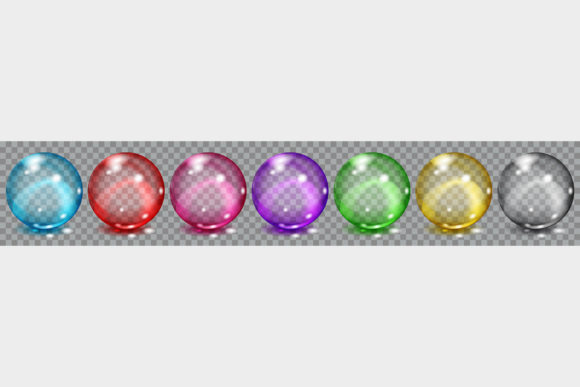
The set described here captures this complexity perfectly. Each sphere features:
- Glares: Bright highlights that indicate the direction of the light source and the smoothness of the surface.
- Shadows: Soft gradients beneath the spheres that ground them in space, preventing them from looking like floating stickers.
- Translucency: The ability to see through the object slightly, adding depth and a sense of material weight.
These attributes are vital for designers who need to break away from the flat design trend without losing clarity. They allow for the creation of interfaces that feel tactile and organic.
Why Transparency Matters: Vector vs. Raster
One of the most common misconceptions among beginners regarding digital graphics is the assumption that all image files support transparency. This is a critical misunderstanding that can lead to frustration when trying to integrate assets into a project. It is important to clarify a fundamental rule: Transparency exists ONLY in vector files.
When you download a set of these spheres, you typically receive two distinct types of files, each serving a different purpose:
- Vector Files (.AI and .EPS): These are the "source" files. They contain mathematical instructions that define the shape, color, and transparency of the sphere. Because they are based on math rather than pixels, they can be scaled to any size without losing quality. Most importantly, the background in these files is truly transparent. You can place a blue sphere over a red gradient, and the colors will blend exactly as intended.
- Raster Files (.JPG): These are preview or print-ready images. A JPG file does not support transparency. If you open the JPG version of this set, you will see the spheres isolated on a white background. The white area is part of the image data, not empty space. Attempting to use a JPG with a white background in a design where you need the sphere to sit on a dark or colorful backdrop will result in a visible white box around your sphere.
To effectively work with the transparency features of this set, you must use a vector editor. Programs like Adobe Illustrator, CorelDRAW, or Affinity Designer are required to open the .ai and .eps files. Once opened in these editors, you can remove the background, change the colors, adjust the opacity, or distort the shape to fit your specific needs.
Exploring the Color Palette and Versatility
The true power of this asset set lies in its diverse color range. The collection includes spheres in light blue, red, green, yellow, purple, pink, and gray. This spectrum covers the primary, secondary, and tertiary colors, providing a comprehensive toolkit for various design scenarios.
Light Blue and Green: These cool tones are often associated with technology, healthcare, nature, and trust. They are perfect for medical infographics, eco-friendly branding, or tech startup websites.
Red and Yellow: These warm, energetic colors grab attention immediately. They are ideal for call-to-action buttons, sale promotions, or highlighting key data points in a presentation.
Purple and Pink: Often used to convey creativity, luxury, or playfulness. These shades work well in lifestyle blogs, fashion magazines, and creative portfolios.
Gray: While neutral, the translucent gray sphere adds a sophisticated, metallic, or industrial feel. It is excellent for architectural visualizations or minimalist designs where color might be too distracting.
Technical Specifications and File Compatibility
For professionals who need to ensure compatibility across different software versions, this set offers robust file options. The package includes high-quality files designed to work seamlessly in industry-standard environments.
The EPS (Encapsulated PostScript) version is provided as version 10. This is a legacy but highly compatible format that ensures the file can be opened by almost any graphic design software, even older versions of Adobe products or free alternatives like Inkscape. It preserves the vector paths and transparency data, allowing for maximum flexibility.
The AI (Adobe Illustrator) file is saved in CC (Creative Cloud) format. This ensures access to the latest editing features, such as advanced blending modes and global swatches, which can speed up your workflow significantly. If you are using the latest version of Illustrator, this file will offer the highest level of editability.
Additionally, the set includes a JPG file with a resolution of 10417×1875 pixels. While this file has a white background and no transparency, it serves a specific purpose. It is perfect for:
- Quick previews of the entire set.
- Printing on white paper where a white background is acceptable.
- Web usage where the background of the webpage is white.
- Situations where a user does not have a vector editor installed.
Practical Applications in Modern Work and Creativity
How do these spheres fit into the daily activities of designers, educators, and business owners? The applications are vast and span multiple industries.
Digital Product Design and UI/UX
In User Interface (UI) design, translucent spheres are frequently used as decorative elements, icons, or background textures. They can simulate bubbles, droplets, or abstract shapes that add a modern, "glassmorphism" aesthetic to mobile apps and dashboards. By using the vector version, a designer can easily change the color of a sphere to match a brand's new palette without needing to redraw the element.
Education and Infographics
Teachers and content creators often struggle to visualize abstract concepts. A set of translucent spheres can represent atoms, cells, planets, or data nodes. The transparency allows text or other diagrams to be layered behind the spheres, creating a rich, multi-layered educational diagram that is easy to read and visually engaging.
Business and Marketing
In marketing materials, such as brochures, flyers, and social media posts, these spheres act as focal points. They can highlight a product, frame a testimonial, or simply add a touch of elegance to a corporate presentation. The inclusion of shadows gives the design a grounded, professional look, avoiding the "cheap" appearance that flat graphics sometimes have.
Artistic Expression
For digital artists, these spheres serve as a starting point for more complex compositions. An artist can take a single vector sphere, duplicate it, apply different gradients, and combine them to create intricate patterns, mandalas, or abstract art pieces. The ability to edit the glares and shadows allows for infinite customization.
Conclusion: Investing in Quality Vector Assets
Understanding the distinction between vector and raster files is the first step toward mastering digital design. The set of translucent colored spheres described here represents a high-value resource because it bridges the gap between visual appeal and technical flexibility. By providing both editable vector files (.ai, .eps) and high-resolution raster files (.jpg), it caters to users at every skill level.
Whether you are a seasoned graphic designer looking to save time on repetitive tasks, a student creating a science project, or a business owner crafting a marketing campaign, these assets provide the tools needed to create professional, eye-catching visuals. Remember, to unlock the full potential of transparency and editing capabilities, always reach for the vector files and open them in a dedicated vector editor like Adobe Illustrator. With the right tools and knowledge, these simple spheres can become the cornerstone of your next great design.