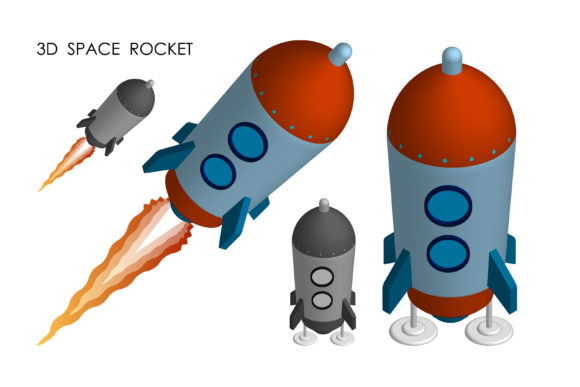
Isometric Flying Space Rocket. Flights: A Visual Tool for Modern Creators and Educators
When you hear the phrase Isometric Flying Space Rocket. Flights, your mind might immediately jump to video game assets or generic clip art. However, in the current digital landscape, this specific visual style represents something far more practical. It is a sophisticated rendering technique that combines depth perception with clean, geometric precision. Unlike flat 2D illustrations that can look dated quickly, or hyper-realistic 3D models that require heavy processing power, an isometric flying space rocket offers a unique sweet spot. It provides a realistic 3D vector aesthetic that remains crisp at any size while maintaining a playful yet professional tone.
This isn't just about drawing a rocket ship; it is about communicating complex ideas about travel, technology, and exploration without overwhelming the viewer. Whether you are a freelancer pitching a new app concept, an educator explaining orbital mechanics, or a small business owner launching a tech product, understanding how to leverage these visuals can significantly elevate your content strategy.
Why This Visual Style Dominates Modern Digital Design
The appeal of the isometric perspective lies in its ability to show three dimensions on a two-dimensional plane without losing clarity. In the context of space exploration, this is crucial. Realistic 3D vector graphics allow designers to depict the intricate details of a spacecraft, the curvature of a planet, or the trajectory of a flight path without the clutter often found in photorealistic renderings.
For creators and marketers, this means your audience gets the "wow" factor of depth without the cognitive load of deciphering a chaotic scene. When you use an image of a rocket flying towards Mars, the isometric angle clearly shows the launchpad, the vehicle, and the destination simultaneously. It tells a complete story in a single glance. This efficiency is why this style has become a staple in UI/UX design, infographics, and technical documentation.
Real-World Applications for Entrepreneurs and Freelancers
Let's talk about where this actually fits into your workflow. If you are a freelancer building a portfolio website, having high-quality, thematic imagery sets you apart from competitors using stock photos. Imagine you are designing a landing page for a startup focused on satellite internet or private space tourism. Using a custom Isometric Flying Space Rocket. Flights illustration immediately signals innovation and forward-thinking.
- Startup Pitch Decks: Investors love clear visuals. Instead of bullet points describing a logistics company that plans cargo flights to the Moon, show them an isometric view of a supply rocket docked at a lunar station. It makes the abstract concrete.
- SaaS Product Interfaces: Many software companies use isometric icons to represent their features. A cloud storage service might use a rocket icon to symbolize speed. A project management tool could use a planetary system to represent different departments working in orbit around a central goal.
- Marketing Campaigns: For holiday sales or special launches, a "flight to success" theme works well. You can create a series of images showing a rocket taking off from Earth, passing the Moon, and arriving at various planets, each representing a milestone or a discount tier.
The versatility here is immense. Because these are vectors, they scale infinitely. You can use a tiny version as a favicon for your blog and a massive version for a billboard at a tech conference without losing quality. This scalability saves money on asset creation and ensures brand consistency across all platforms.
Educational Scenarios: Making Complex Science Accessible
Educators and content creators in the STEM fields face a constant challenge: making complex data engaging. Traditional textbooks often rely on static diagrams that fail to capture the dynamic nature of space travel. Isometric illustrations bridge this gap effectively.
Consider a lesson plan about the solar system. Instead of a flat map, an instructor can use a series of isometric views showing a rocket traveling from Earth to Mars. The visual difference between the red surface of Mars and the blue oceans of Earth becomes starkly apparent when viewed from a consistent, angled perspective. This helps students visualize distances and trajectories better than a simple line graph ever could.
Furthermore, for homeschoolers or online course creators, these visuals serve as excellent hooks. A short video or interactive module featuring a realistic 3D vector rocket navigating asteroid belts keeps attention spans higher. It transforms a lecture into an adventure. When discussing technologies for space, such as ion propulsion or nuclear thermal rockets, an isometric cutaway view can reveal the internal mechanisms in a way that feels like peering inside a machine, fostering curiosity and deeper understanding.
Technical Considerations for Content Creation
If you are looking to integrate Isometric Flying Space Rocket. Flights into your projects, there are a few practical factors to consider before you start downloading or commissioning work. First, understand the file format. Since the prompt emphasizes "realistic 3D vector," you should be looking for SVG or EPS files. These formats ensure that the lines remain sharp whether you are printing a brochure or displaying on a 4K monitor.
Second, consider the color palette. Space is often associated with deep blacks and vibrant neons, but for professional use, a muted, earthy palette combined with metallic accents often conveys reliability and engineering excellence. Avoid overly cartoonish colors unless your target audience is strictly children. Adults aged 20–50 generally prefer designs that feel grounded in reality, even when depicting futuristic concepts.
Third, think about the narrative arc. A single image of a rocket is nice, but a sequence is powerful. Create a journey. Show the takeoff, the mid-flight cruise past Jupiter, and the final approach to a planet. This storytelling approach engages the user emotionally. It moves beyond a simple decoration and becomes a functional part of your communication strategy.
Bridging the Gap Between Hobbyists and Professionals
You don't need to be a NASA engineer to appreciate the utility of these visuals. Hobbyists who run blogs about space news, astronomy enthusiasts, or DIY makers interested in rocketry can all benefit from using high-quality isometric assets. They add a layer of professionalism to personal projects that usually looks amateurish.
For instance, a blogger writing about the latest SpaceX launch can pair their text with an isometric graphic of the Starship. This not only breaks up the wall of text but also provides a visual reference point for readers who might not have seen the actual footage. Similarly, small business owners in the aerospace supply chain can use these images to illustrate their role in the larger ecosystem, perhaps showing a component being installed on a rocket destined for the Moon.
The key is to treat these images as tools for communication rather than just decorations. Ask yourself: Does this image help explain my point? Does it make the technology seem accessible? If the answer is yes, then the Isometric Flying Space Rocket. Flights concept is serving its purpose.
Moving Forward with Strategic Visuals
In a world saturated with information, standing out requires more than just good copy; it requires compelling visuals. The Isometric Flying Space Rocket. Flights niche offers a perfect blend of creativity and functionality. It allows you to discuss advanced topics like interplanetary travel and cutting-edge space technologies in a way that is visually digestible and aesthetically pleasing.
Whether you are building a presentation for investors, designing a curriculum for students, or simply updating your personal brand, incorporating these elements can elevate your output. By focusing on the practical outcomes—better engagement, clearer explanations, and a more professional appearance—you turn a simple graphic choice into a strategic advantage. As we move further into an era where space exploration becomes a tangible reality for more people, having the right visual language to describe it will become increasingly valuable. Start thinking about how your next project could benefit from a flight to Mars, rendered in perfect isometric detail.