Isometric Flag of United States America: Design & Motion
The Isometric Flag of United States America represents a fascinating intersection between traditional symbolism and modern geometric design. Unlike standard two-dimensional representations, this style adds depth, perspective, and volume to the iconic Stars and Stripes. By utilizing isometric projection, designers transform a flat image into a tangible-looking object that appears to exist in a three-dimensional space without losing its recognizable identity. This approach offers a fresh visual language for anyone looking to convey patriotism, professionalism, or creativity in a digital-first world.
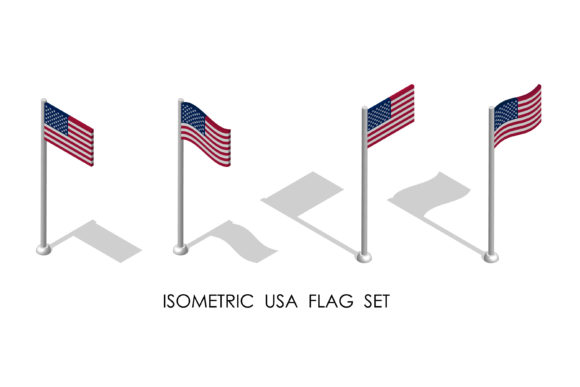
When you encounter an isometric flag of United States of America, you are seeing more than just a graphic; you are seeing a structural interpretation of national identity. The static version often serves as a powerful icon for websites, mobile applications, and infographics where space is limited but impact is required. The motion variant, featuring the flag waving on a pole, introduces dynamic energy, making it ideal for video content, presentations, and animated branding materials. Both forms leverage 3D vector technology to ensure crisp lines and scalability across any medium.
Understanding the Isometric Perspective
To appreciate the utility of this design style, one must first understand the mechanics of isometric projection. In this specific type of parallel projection, the three coordinate axes appear equally foreshortened, and the angles between any two of them are exactly 120 degrees. This mathematical precision allows the flag to be rendered with a consistent scale, eliminating the distortion found in perspective drawings. For creators, this means the design remains clean, organized, and professional regardless of how large or small it is displayed.
The appeal lies in the balance between abstraction and realism. A standard photograph captures light and shadow realistically, while a flat vector lacks dimension. The isometric style sits perfectly in the middle. It retains the symbolic clarity of the flag—the red and white stripes, the blue canton, and the fifty stars—while adding a layer of sophistication through shading, highlights, and geometric construction. This makes it particularly effective for educational materials, corporate reports, and technical illustrations where clarity is paramount.
Static Applications for Digital Assets
The static isometric flag of United States America is a versatile asset for web developers and UI/UX designers. In the realm of user interface design, icons need to be instantly recognizable yet distinct from standard clip art. An isometric flag can serve as a unique country selector, a localization indicator, or a badge for verified American businesses. Because it is created as a 3D vector, it scales infinitely without pixelation, ensuring it looks sharp on everything from low-resolution smartwatches to massive 4K monitors.
- Infographics: Use the flag as a data point marker to represent statistics related to the US economy, population, or geography. The added depth helps the element stand out against complex charts.
- App Icons: Create a custom app icon for location-based services or government-related tools. The isometric view suggests functionality and structure.
- Print Media: Incorporate the design into brochures, business cards, or presentation slides. The geometric look aligns well with modern, minimalist print trends.
For entrepreneurs and small business owners, using this specific style signals attention to detail. It suggests that the brand values precision and modern aesthetics. When placed next to text or other graphical elements, the isometric flag acts as a visual anchor, drawing the eye and establishing a sense of authority and trust.
Motion Design: Bringing the Flag to Life
Moving beyond the static image, the concept of an isometric flag of United States of America in motion on flagpole opens up a new realm of creative possibilities. Animation breathes life into geometry. Imagine the flag gently rippling in a virtual breeze, the fabric folding over itself with realistic physics, all while maintaining the rigid isometric grid. This combination of structured geometry and fluid motion creates a mesmerizing visual effect that captures attention immediately.
In marketing and advertising, motion is king. A looping animation of the flag on a pole can be used as a background for landing pages, a transition effect in video edits, or a loading screen that keeps users engaged while content loads. The key here is subtlety. The motion should not be chaotic or overwhelming; it should be smooth and rhythmic, mimicking a calm day with a steady wind. This adds a human touch to digital interactions, making the experience feel more organic and less robotic.
- Social Media Content: Short, looping GIFs or MP4s are highly shareable. An animated isometric flag can celebrate holidays like Independence Day or Memorial Day with a modern twist that stands out in crowded feeds.
- Video Presentations: Speakers can use these animations as visual aids during talks about national policy, history, or business expansion. The movement keeps the audience focused on the slide.
- Web Backgrounds: A subtle, looping animation in the corner of a website header can add personality without distracting from the primary content.
Adapting Styles for Diverse Audiences
One of the greatest strengths of the isometric flag is its adaptability. Different audiences respond to different visual cues, and designers can tweak the style to match their specific goals. For an educational context, such as a textbook or an online course, the colors might be kept bright and true to the official flag specifications to ensure accuracy. However, for a creative portfolio or a tech startup, the color palette can be adjusted. Using monochromatic schemes, neon accents, or pastel tones can make the flag feel contemporary and trendy.
Consider the texture as well. While the base is a vector, adding subtle textures like brushed metal, paper grain, or glass effects can change the entire mood. A metallic finish might suit a financial report, suggesting stability and wealth. A matte, paper-like texture could work better for a blog post about history or literature. These variations allow the same core asset to serve multiple purposes within a single project.
It is also important to consider the context of usage. If the flag is being used in a political campaign, the design should remain respectful and clear. If it is part of a gaming interface or a fantasy world map, the artist has more freedom to stylize it, perhaps adding glowing edges or futuristic elements. The isometric framework provides the structure, but the artistic direction defines the message.
Best Practices for Implementation
To get the most out of your isometric flag of United States America projects, consistency is key. Whether you are creating a single icon or a full suite of graphics, maintain uniform lighting, shadow angles, and line weights. Inconsistent rendering can make a design look amateurish and distract from the intended message. Always ensure that the proportions of the flag remain correct relative to the pole and the mounting mechanism.
Optimization is another critical factor, especially for web use. Since these are 3D vectors, they can become file-heavy if not managed correctly. Convert complex renders into optimized SVG files for the web whenever possible. This ensures fast load times and accessibility. For motion assets, keep frame rates reasonable and loop points seamless to avoid jarring cuts that break the immersion.
Finally, always respect the symbolism. The flag is a potent symbol of national identity. Even when stylized creatively, the core elements should remain recognizable. Avoid distorting the layout to the point where the stars and stripes are unidentifiable. The goal is to enhance the visual appeal, not obscure the meaning. By balancing creativity with respect, you create designs that are both engaging and appropriate for a wide range of professional contexts.
Whether you are a freelancer looking to expand your portfolio, a marketer seeking to elevate a campaign, or an educator wanting to make learning materials more engaging, the isometric flag offers a robust toolset. It bridges the gap between classic imagery and modern design trends, providing a versatile solution for visual communication in the digital age.